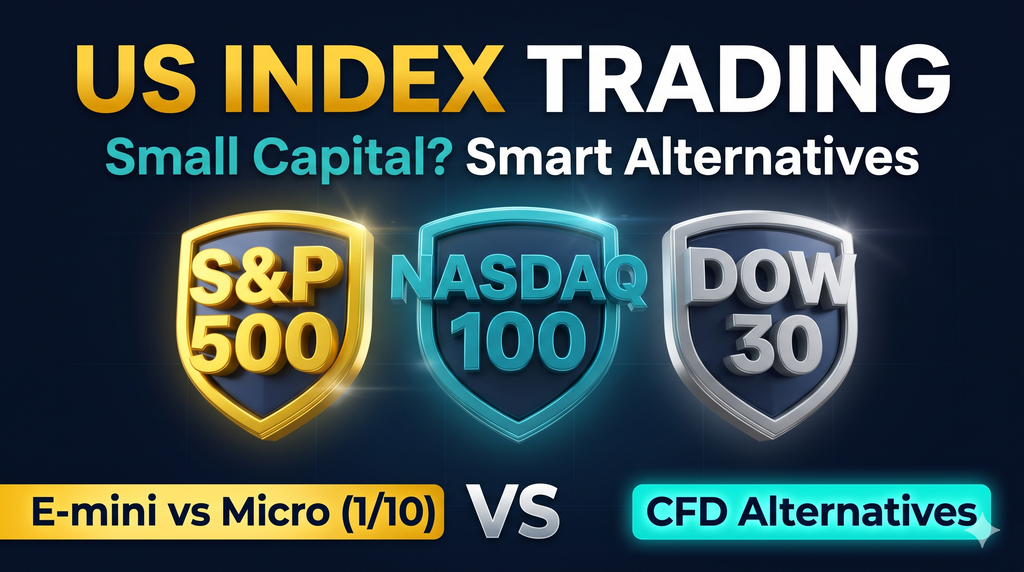
When trading US equities or equity index futures, the foundational benchmarks everyone watches are the S&P 500, Nasdaq 100, and Dow Jones Industrial Average (Dow 30).
While each index follows distinct inclusion criteria and weighting methodologies, an inside look reveals that the mega-cap tech giants driving the US market simultaneously dominate all three.
This guide breaks down the overlapping holdings across these indices, contrasts the contract specifications and margin requirements between E-mini and Micro futures, and explores Index CFDs as an ultra-flexible alternative when standard margin requirements are out of reach.
1. How Much Do They Overlap? (Holdings Breakdown)
① The 7 Powerhouse Stocks in All Three Indices
All 30 components of the Dow Jones Industrial Average are fundamentally included in the S&P 500. Among them, the non-financial mega-caps listed on the Nasdaq exchange are included in the S&P 500, Nasdaq 100, and Dow 30 simultaneously:
- Apple (AAPL)
- Microsoft (MSFT)
- NVIDIA (NVDA)
- Amazon (AMZN)
- Cisco Systems (CSCO)
- Amgen (AMGN)
- Honeywell (HON)
Key Takeaway: The “Big Four” tech titans—Apple, Microsoft, NVIDIA, and Amazon—steer the directional momentum across the entire US equity landscape at the same time.
② Cross-Index Overlap Dynamics
- S&P 500 vs. Dow 30: Virtually 100% of Dow 30 components are part of the S&P 500.
- S&P 500 vs. Nasdaq 100: Excluding financial stocks, roughly 80 to 85 US large-caps in the Nasdaq 100 (Alphabet, Meta, Tesla, Broadcom, etc.) belong to the S&P 500, making up over 40% of the S&P 500 by market capitalization weight.
- Nasdaq 100 vs. Dow 30: Because the Nasdaq 100 excludes financial institutions and NYSE-only listings, traditional industrials and financial blue chips (JPMorgan Chase, Boeing, Caterpillar, etc.) do not qualify. Their overlap is strictly confined to the dual-listed tech giants mentioned above.
2. Structural Overview: The Big 3 at a Glance
| Index | Component Count | Weighting Method | Primary ETFs | Core Profile |
| S&P 500 | 503 | Market-Cap Weighted | SPY, VOO | The definitive benchmark for broad US large-cap equities |
| Nasdaq 100 | 101 | Modified Market-Cap Weighted | QQQ | Tech-heavy, high-growth focus (excludes financials) |
| Dow Jones 30 | 30 | Price-Weighted | DIA | 30 prominent, high-priced traditional blue-chip leaders |
3. CME Futures: E-mini vs. Micro Specifications & Margin
The steepest barrier to entry when transitioning to index futures is contract notional value and margin requirements.
① Why E-mini Contracts Are Capital Intensive
- E-mini Nasdaq 100 (NQ) has a point multiplier of $20. With the index trading comfortably above 20,000 points, a single contract commands a notional value exceeding $400,000–$500,000.
- Consequently, CME and retail brokers require an overnight maintenance margin in the ballpark of $40,000 to $45,000, which presents a substantial capital hurdle for individual retail accounts.
② Slashing Capital Requirements by 90%: Micro E-mini Futures
- For traders operating with smaller accounts or seeking precise scaling, Micro E-mini contracts (MNQ, MES, MYM) offer the exact same price action at $\frac{1}{10}$ the size.
- With both the tick value and required margin reduced to 10%, you can trade 1 contract of Micro Nasdaq (MNQ) with roughly $4,000 to $4,500 in margin.
| Index | Contract Tier | Symbol | Multiplier | Tick Value | CME/Broker Maint. Margin | Market Profile |
| S&P 500 | E-mini | ES | $50 | $12.50 (0.25 pt) | ~$24,000 – $27,000 | Deep institutional liquidity, thick order book |
| Micro | MES | $5 | $1.25 (0.25 pt) | ~$2,400 – $2,700 | Ideal for scaling entries and risk management | |
| NASDAQ | E-mini | NQ | $20 | $5.00 (0.25 pt) | ~$42,000 – $45,000 | High volatility, rapid daily range expansion |
| Micro | MNQ | $2 | $0.50 (0.25 pt) | ~$4,200 – $4,500 | The retail day-trader standard | |
| Dow | E-mini | YM | $5 | $5.00 (1.00 pt) | ~$15,000 – $17,000 | Moderate liquidity, stable industrial focus |
| Micro | MYM | $0.50 | $0.50 (1.00 pt) | ~$1,500 – $1,700 | Lowest absolute margin requirement |
(Note: Official exchange margins fluctuate periodically depending on underlying volatility and index price levels.)
4. When Even Micro Margins Feel Heavy: The CFD Alternative
🚨 Regulatory Notice: Illegal for US Residents!
CFDs (Contracts for Difference) are over-the-counter (OTC) derivatives. Under SEC and CFTC regulations, CFD trading is strictly illegal for US citizens and US tax residents.
This alternative applies exclusively to non-US international traders operating under jurisdictions where retail CFDs are legally permitted.
Even a $4,000 margin for 1 Micro Nasdaq contract can commit too much capital for smaller retail accounts. In this scenario, global broker-offered Index CFDs (e.g., NAS100, US500, US30) provide a viable alternative.
Why Small-Account Traders Look at CFDs
- Fractional Lot Sizing: Regulated exchange futures cannot be divided below 1 contract. CFDs, however, allow positions as small as
0.01 lotor0.1 lot, giving granular control over position sizing. - Minimal Margin Requirements: Depending on broker leverage tiers, you can open an index position with just a few tens to hundreds of dollars.
- Flexible Risk Management: Without forcing all-in exposure on full-size contracts, traders can properly test execution strategies, manage dollar-based stop-outs, and scale in/out smoothly.
Reference Links & Further Reading
- Official Exchange Specifications
- CFD Fundamentals & Regulation
- CFD Broker Recommendation