
The CFA Won’t Save Your Day Trades: Master Orthodox Market Mechanics (CMT, CFTe) Before Falling for Heretical YouTube Setups
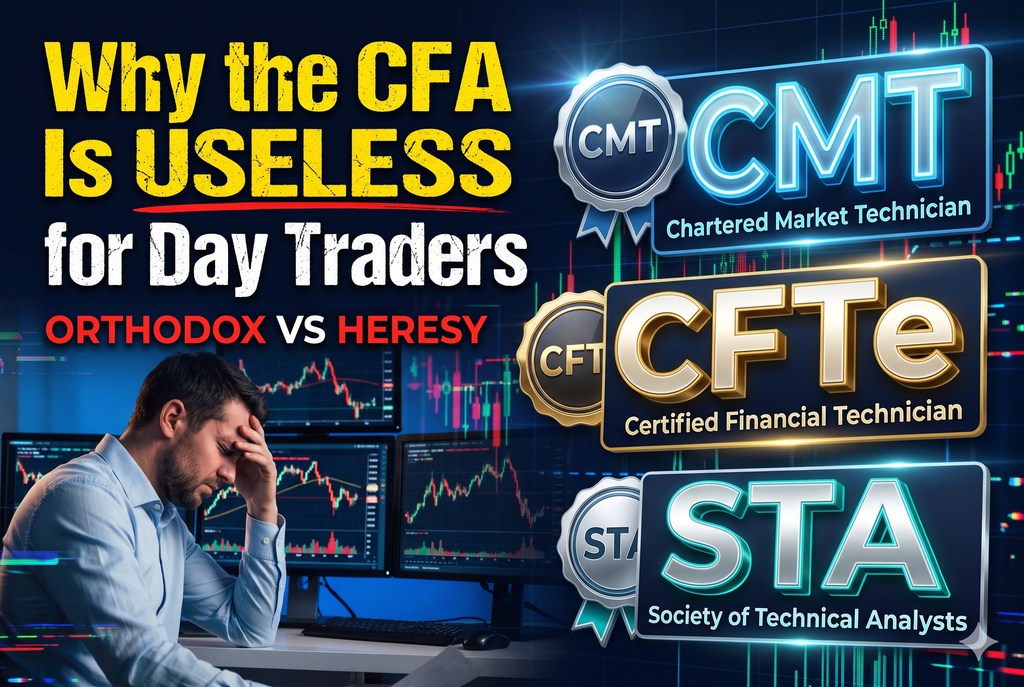
In the institutional finance world, the CFA (Chartered Financial Analyst) charter reigns supreme.
For an active day trader scalping tick-by-tick on the order book, however, the CFA mostly elicits a cynical shrug. Analyzing DCF models, decoding balance sheets, and calculating enterprise multiples mean next to nothing when you are sitting in front of a 1-minute NASDAQ futures chart or a volatile domestic microcap that dumps out of nowhere five minutes after the opening bell.
What a day trader needs is not macroeconomic thesis building, but Technical Analysis—the mechanics of interpreting immediate price action, volume profiles, and market psychology.
The real problem is where to learn it.
Browse YouTube, X, or Telegram, and you will drown in technical analysis tutorials. Flashy thumbnails promise “90% win rates” and “secret smart money footprints.” In the martial arts framework, this is purely heretical kung fu (사파 무공, 邪派武功).
Heretical trading techniques are not inherently useless. Gritty street-level setups, price action quirks, and improvised scalp tricks born in retail trenches do occasionally work.
Yet, jumping straight into heretical techniques without a foundational core guarantees account blowups (주화입마, 走火入魔):
- Beginners lack the framework to separate legitimate edge from toxic snake oil.
- Even when a rogue setup functions, traders cannot decipher the underlying market mechanics and liquidity drivers behind why the pattern worked. Memorizing static chart shapes without grasping auction mechanics means immediate ruin the moment market regime shifts.
To exploit unconventional trading tricks without poisoning your edge, you must first master orthodox discipline (정파 무공, 正派武功) to build structural market literacy.
Historically, the fastest and most unforgiving way to force orthodox market mechanics into your skull is simple: studying an institutional exam curriculum.
Committing capital, booking an exam date, and plowing through a standardized body of knowledge forces an objective mental map of classic technical analysis.
This brings up an obvious practical question: “If I have zero intention of submitting a corporate resume to Wall Street or Yeouido, do I actually need an overpriced certificate?”
For independent prop traders, writing the exam can be a redundant expense. What actually matters is extracting the orthodox curriculum, reading lists, and problem sets for self-directed study.
Here is an unvarnished breakdown of the global big three in technical analysis certifications—their fee structures, curriculum accessibility, and prep infrastructures.
1. CMT (Chartered Market Technician) — “Wall Street’s All-Inclusive Corporate Bundle”
- Governing Body: CMT Association (USA)
- Prestige: The definitive gold standard on Wall Street. FINRA officially recognizes the charter by waiving the technical analysis component of the Series 86 Research Analyst exam.
- Cost Structure: The historical loophole of joining as an affiliate member to shave off individual exam fees has been eliminated. The CMT Association shifted to a mandatory “All-Inclusive Bundle” model:
- Early Registration: $875
- Standard Registration: $1,075
- Late Registration: $1,475
- The bundle bundles the official digital curriculum, an Optuma charting software license, and NASDAQ Dorsey Wright research data into one mandatory ticket price.
- Curriculum Accessibility: Closed Ecosystem. In earlier years, Wiley sold official CMT Level 1–3 curriculum textbooks as standalone hardcovers on Amazon. Today, the association restricts access behind their expensive, mandatory registration wall.
- Practice Question Infrastructure: Top-Tier. American test-prep capitalization is evident here. Through official partners like UWorld, candidates gain access to slick computer-based test engines, comprehensive question banks (QBank), and simulated mock exams. The prep infrastructure is seamless, assuming you are willing to pay for it.
2. CFTe (Certified Financial Technician) — “Classic Canon Books, Barren Prep Landscape”
- Governing Body: IFTA (International Federation of Technical Analysts)
- Prestige: A decentralized global federation prominent across Europe, Asia, and Latin America. It consists of a streamlined two-tier framework: Level 1 (Multiple Choice) and Level 2 (Written Chart Essay Analysis).
- Cost Structure: Maintains a split between member and non-member pricing:
- Level 1: Member $550 / Non-Member $850
- Level 2: Member $850 / Non-Member $1,150
- (Does not bundle unwanted proprietary software).
- Curriculum Accessibility:Completely Open. IFTA publishes no proprietary all-in-one corporate textbook. Instead, the syllabus defines an open Reading List composed of classic market literature:
- John J. Murphy, Technical Analysis of the Financial Markets
- Martin J. Pring, Technical Analysis Explained
- Robert D. Edwards & John Magee, Technical Analysis of Stock Trends
- Anyone can purchase these masterworks directly from commercial bookstores for nominal costs without touching IFTA’s exam registration portal.
- The Prep Reality:No Commercial QBank Ecosystem. Searching for “CFTe prep” often pulls up unrelated entities, such as European fintech academies (e.g.,
cfte.education) or IT certification dumps. IFTA runs no unified video portal or dedicated question-bank SaaS.- Video Courses: IFTA points toward member-society initiatives, such as the UK Society of Technical Analysts (STA) Home Study Course, as recognized training.
- Crucial Detail on Practice Questions:The primary textbooks do not contain exercise problem sets. The publishers separated question banks into distinct workbooks:
- Study Guide to Technical Analysis of the Financial Markets (John J. Murphy)
- Study Guide for Technical Analysis Explained (Martin J. Pring)
- For self-directed traders, buying these standalone study guides on Amazon yields authentic multiple-choice quizzes, true/false drills, and chart interpretation exercises without exam fees.
3. STA Diploma — “The Traditional London City Guild Apprenticeship”
- Governing Body: Society of Technical Analysts (UK)
- Prestige: Deeply embedded within London trading desks and European institutional institutions.
- Cost Structure: Distinctly British academic packaging. The STA rarely lists bare examination tickets on its landing pages. Instead, mandatory coursework (Home Study or Evening Course modules) bundles the examination vouchers directly (£800 to £1,500+ per level).
- Curriculum & Infrastructure: Proprietary binder materials, courseware, and past paper examiner reports unlock exclusively after purchasing an official tuition course. The actual exams, however, are accessible internationally via remote online proctoring from your home trading station.
Comparative Overview
| Specification | CMT (US) | CFTe (Global/Europe) | STA Diploma (UK) |
| Governing Body | CMT Association | IFTA | Society of Technical Analysts (STA) |
| Levels | Levels 1, 2, 3 | Levels 1, 2 | Parts 1, 2 |
| Testing Format | Prometric Center / Remote | Online CBT / Testing Center | Online Remote Proctoring |
| Direct Exam Cost | $875 – $1,475 (Mandatory Bundle) | $550 – $1,150 (Member / Non-Member) | Course-Bundled (£800–£1,500+) |
| Textbook Availability | Gated (Locked inside exam registration) | Open (Accessible classic bookstore canon) | Gated (Internal course binder format) |
| Official Prep Courses | Standardized via corporate partners (UWorld) | Decentralized / STA Course integration | Comprehensive proprietary course modules |
| Question Bank Access | Extensive (Polished digital QBanks) | Standalone Workbooks (Murphy/Pring Study Guides) | Restricted (Past papers locked to students) |
| Best Target Profile | Institutional CV branding & FINRA waivers | Self-taught traders mining pure market logic | Traders pursuing European desk traditions |
The Rational Trader’s Takeaway
A physical certification diploma will not fix sloppy execution, poor sizing, or hesitating on stops. An algorithm does not care if its operator holds a charter.
For traders focused solely on refining their edge, the efficient path is clear:
- Bypass the CMT registration markup: Spending $1,000+ purely to view foundational textbooks makes little sense if institutional credentials are not required.
- Reverse-engineer the CFTe Reading List: Purchase John J. Murphy and Martin J. Pring’s seminal volumes directly from regular booksellers.
- Drill the companion workbooks: Pair those primary texts with their separate Study Guides to test conceptual retention against real chart patterns.
Internalizing the classical auction principles laid out in these foundational texts provides the mental clarity to scrutinize any YouTube setup. You immediately spot whether an influencer’s technique is a derivative of classic volume divergence or reckless marketing fiction. Master orthodox market mechanics first; only then do heretical tactics become valuable tools in your daily routine.