
“You finally understand market structure, your setups are clicking, but your trading account sits at a frustrating $1,000 or $2,000.”
Anyone who has taken trading seriously has hit this exact wall. Even if you pull off an exceptional 10% monthly return on a $1,000 balance, you walk away with just $100 for an entire month of discipline. Out of sheer impatience, most retail traders inevitably crank up the leverage to force meaningful gains, ending with a blown account.
What if you could pay an evaluation fee of around $100, prove your consistency, and manage an account worth $50,000 to over $100,000—keeping 80% to 90% of the profits you generate?
While it sounds too good to be true, this is the core premise behind modern online prop firms (proprietary trading firms). For skilled traders who lack capital, a prop firm can act as a powerful leverage tool—allowing you to trade institutional size without risking your life savings.
However, there is no free lunch in financial markets. Beneath this massive upside lies an industry where roughly 95 out of 100 traders fail due to strictly engineered drawdown rules and psychological traps.
Here is what a prop firm really is, why undercapitalized traders find it so compelling, and what you must watch out for before attempting a challenge.
1. What Is an Online Prop Firm?
Traditionally, proprietary trading meant financial institutions trading their own capital directly on institutional exchanges. Modern retail prop firms operate differently:
- Evaluation Model: Traders pay an upfront entry/evaluation fee to take a “Challenge” on a simulated account.
- Profit Split: Traders who pass the evaluation receive a “Funded” account and can keep 70% to 90% of generated profits, while the prop firm retains the remaining 10% to 30%.
Who Uses Prop Firms?
| Trader Profile | Motivation | Common Pitfall |
| Undercapitalized Traders | Want to trade large capital without risking their personal savings ($1k–$5k). | Overleverage and fail the strict daily loss rules within days. |
| Full-Time Candidates | Test strategies and build discipline under formal risk parameters. | Experience psychological burnout due to strict drawdown restrictions. |
| System / Copy Traders | Scale a proven edge by copying trades across multiple prop accounts. | Breached by latency slippage, broker feed disparities, or banned EA rules. |
2. Major Models Compared: CFD vs. Futures Prop Firms
The prop firm industry is largely divided into two main categories: CFD/Forex-based and US Exchange Futures-based.
| Feature | CFD / Forex (e.g., FTMO) | US Futures (e.g., Apex Trader Funding) |
| Primary Assets | Nasdaq (NAS100), Gold (XAUUSD), FX pairs, Crypto | CME Futures: E-mini Nasdaq (NQ), S&P (ES), Crude Oil (CL) |
| Trading Platforms | cTrader, MetaTrader 4/5, DXtrade | Tradovate, NinjaTrader, Quantower (via Rithmic) |
| Challenge Structure | 1-Step or 2-Step evaluations with static balance rules | Typically 1-Step profit target |
| Pricing & Discounts | Regular pricing; rarely offers heavy discounts | Persistent 80% to 90% off coupon promotions |
| Payout Process | Consistent, automated, clear criteria | Heavy scrutiny, strict consistency rules, delayed reviews |
| Reputation Profile | Established standard, higher barrier to entry | Cheap to join, but requires navigating strict withdrawal policies |
3. The Business Model: How Do Prop Firms Afford 90% Payouts?
Why would a company hand over 90% of profits while taking on market risk? The answer lies in evaluation failure rates and internal simulated execution (B-Book).
[100 Traders Enter Evaluations]
       ↓
[95% Fail the Evaluation] → Evaluation and reset fees go directly to company revenue.
       ↓
[5 Traders Pass to Funded Stage]
       ↓
[4 Traders Breach Funded Rules] → Eliminated by daily drawdown; payout owed: $0.
       ↓
[1 Trader Successfully Withdraws] → Paid out from the pool of failed evaluation fees.
- Simulated Environment (B-Book): Most retail prop firms do not send orders directly to real liquidity providers (A-Book). Even “funded” accounts typically run on internal simulated demo servers.
- Cash Flow Engine: Successful trader payouts are funded by the vast volume of paid evaluation fees, resets, and monthly subscription charges from failed participants.
4. The Rules That Break Traders: Why Funded Accounts Blow Up
Passing an evaluation is only the first hurdle. The operational rules are mathematically designed to challenge emotional trading:
| Rule | Definition | Why Traders Fail |
| Daily Drawdown (e.g., 5%) | The maximum loss allowed in a single trading day, calculated from balance or equity. | Averaging down into a losing trade; hitting the threshold intraday. |
| Trailing Drawdown | A loss threshold that trails the highest unrealized profit peak. | Floating unrealized profit drops back to break-even, instantly liquidating the account. |
| Minimum Trading Days | Requires trading across a set number of active days regardless of profit. | Rushing micro-lots just to log days, leading to reckless trades. |
| High-Impact News Bans | Prohibits entering trades minutes before and after major releases (CPI, FOMC). | Unintentionally holding positions during high volatility windows. |
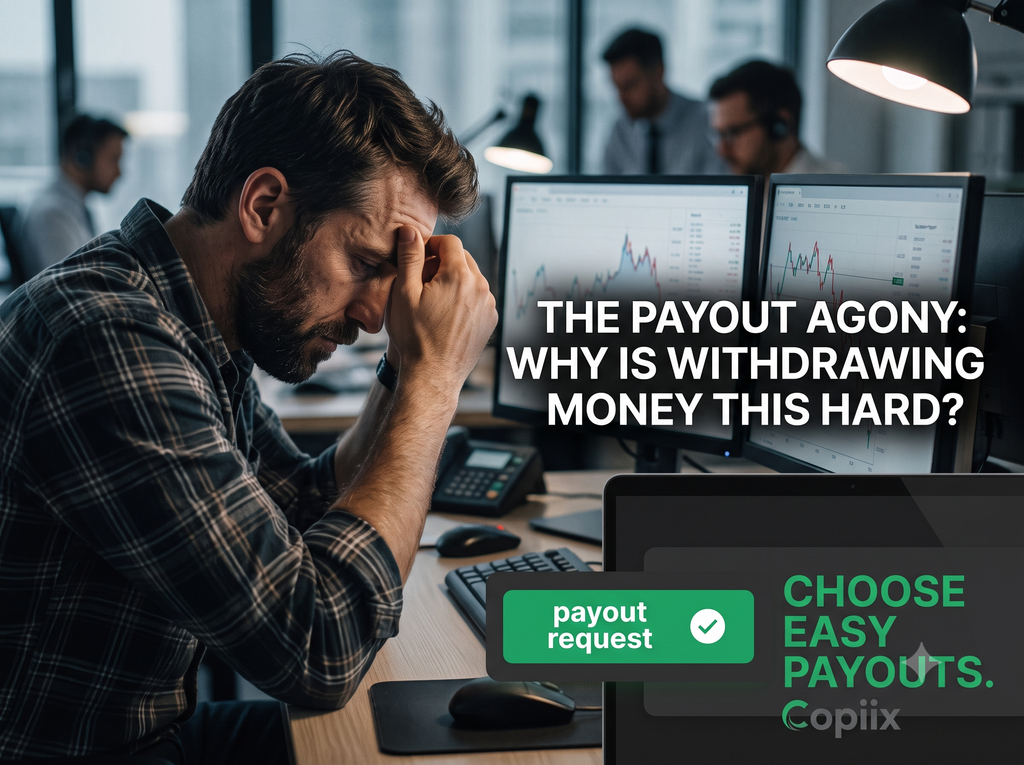
5. The “80% Discount” Trap: Why Traders Shiver with Anxiety on Payout Day
Discount-heavy prop firms make entry ridiculously cheap—slashing a $300 evaluation down to just $35 with endless 80% to 90% coupon codes. However, this is a calculated business model: they lower the barrier at the front door only to build an impassable minefield at the payout window.
Browse Reddit (r/Forex, r/Daytrading), Trustpilot, or Discord trading hubs, and you will see endless horror stories of traders who passed every challenge, generated thousands of dollars in profit, and then spent two weeks biting their nails, terrified their payout would be rejected. At aggressive discount-driven firms (frequently discussed in the futures prop community), getting funded is easy—getting paid is where the real battle begins.
The Payout Minefield That Keeps Traders Up at Night:
- The Brutality of Intraday Trailing Drawdown: Unlike static balance-based firms, trailing drawdown tracks unrealized intraday gains in real time. If your trade spikes to +$2,000 and pulls back to +$500, your loss limit stays locked near the peak. You can blow an account while still sitting in net profit.
- The Dreaded “Consistency Rule”: Even if you trade within the rules, making more than 20% to 30% of your total profit on a single “lucky” day can get your payout rejected. Firms will force you to keep trading to dilute the percentage, keeping your balance at risk until you inevitably breach a rule.
- Vague “Subjective Discretion” Clauses: Many budget firms reserve the right to void profits under ambiguous definitions like “gambling behavior,” “excessive bracket usage,” or “sub-10-second scalping.” When you hit the withdrawal button, your trades undergo forensic-level scrutiny where subjective rules can wipe out weeks of hard work.
- Staged Payout Drips: Even approved traders rarely get all their money at once. Initial withdrawals are often capped at $1,500 to $2,000 every few weeks. The firm’s goal is simple: keep the bulk of your capital locked inside the platform so market volatility blows the account before you ever drain it.
Until the wire actually hits your bank account, you never truly know if the money is yours. That psychological dread is the hidden price of a “$35 challenge.”
6. How to Choose a Reliable Prop Firm: Evaluation Checklist
Before purchasing an evaluation, review the fine print against this checklist:
| Criteria | High-Quality Firm (e.g., FTMO) | High-Risk / Low-Cost Firm |
| Drawdown Type | Static / Balance-Based (does not trail unrealized intraday gains) | Intraday Live Trailing Drawdown |
| Discount Behavior | Retains standard pricing; focus is on long-term client retention | Permanent 80%–90% coupon campaigns |
| Payout Transparency | Clear criteria, predictable schedules, documented track record | Subjective review periods and variable consistency rules |
| Operating History | Multi-year track record with third-party verified payout records | Newly launched, unverified business entities |
| Platform Standards | cTrader, MT5, standard retail terminals | Proprietary locked web platforms with poor execution depth |
The Brutal Bottom Line: Do Not Mistake Cheap Discounts for Cheap Money
If you remember only one thing from this entire article, let it be this: The size of the upfront discount is directly proportional to the severity of the payout minefield.
A 90% coupon code is not generous marketing; it is a customer-acquisition funnel designed to turn traders into recurring subscription payers while keeping the withdrawal vault locked from the inside.
- The entry fee is a vanity metric: Anyone with $35 can gamble their way through an evaluation on a lucky Friday afternoon.
- The payout receipt is the only real proof: If a firm uses ambiguous consistency rules, trailing drawdown traps, or fine-print technicalities to deny your hard-earned profits, that account is worth precisely zero.
Stop shopping for the cheapest challenge. Shop for the firm that actually honors withdrawals without making you beg for your own money.
7. Why Serious Prop Traders Run Multiple Prop firm Accounts: Bypassing the Capital Cap
The biggest reason experienced traders run multiple accounts through a trade copier is simple: Prop firm capital limits (Max Allocation Cap).
Every prop firm sets a strict upper limit on how much capital a single trader can manage. Once you hit that ceiling, you cannot grow your account size any further within that platform. To scale their monthly income, traders have no choice but to stack multiple accounts and copy trades simultaneously.
| Limitation Factor | The Problem with a Single Account | How Multi-Account Trade Copying Solves It |
| Max Allocation Cap | Firms enforce strict caps (e.g., FTMO limits $400k max capital per person; Apex allows up to 20 accounts max). | You max out the allocation limit by holding multiple $50k–$100k accounts simultaneously. |
| Bypassing Growth Ceilings | You cannot get an account beyond the firm’s upper limit even if you are consistently profitable. | Link accounts across multiple prop firms (e.g., FTMO + Topstep + Apex) and scale total capital past $1M+. |
| Payout Ceilings | Many firms cap the maximum payout per account per withdrawal cycle. | Cashing out $2,000 across 5 individual accounts nets $10,000 per payout cycle. |
The Reality of the Scaling Wall
- Firm Allocation Ceilings: Most firms will not give a single trader unlimited funding to protect their own risk exposure. If you reach FTMO’s $400k limit, you must go to other firms or open the maximum permitted number of sub-accounts under that cap.
- One Trade, Maximum Capital Exposure: Instead of manually switching screens, a trade copier lets you place one trade on your master account and instantly execute it across your entire allowed account limit.
Final Thoughts: The Proper Strategy for Prop Trading
A prop firm challenge should not be approached as a lottery ticket. The risk parameters (such as the 5% daily drawdown rule) leave minimal room for error.
To navigate these conditions effectively:
- Avoid relying solely on discount marketing: Review the withdrawal policy thoroughly before paying an evaluation fee.
- Control risk externally: Keep risk parameters locked between 0.5% and 1% per setup on a master manual or algorithmic setup, and rely on disciplined execution rather than emotional recovery trading.
Obviously, the holy grail is developing a fully automated trading bot (EA) that executes trades across dozens of prop accounts with zero emotional interference. But you don’t have to sit on the sidelines waiting until you become an algorithmic genius.
You can simply replicate your regular manual trading—placing orders on a single master account and having them copied instantly across 5, 10, or more prop firm accounts in sub-second speed.